About Bioline AgroSciences
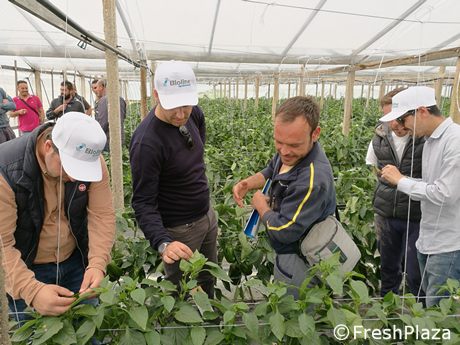
Bioline AgroSciences produces and markets a wide range of invertebrate biological control organisms which are used for control of insect pests in a variety of crops. We are a global company, active in 30 different countries, with particular strength in Europe and North America. Our primary target crops are protected vegetables, ornamentals, soft fruits, and berries. At Bioline AgroSciences we pride ourselves on providing the highest quality products and service in order to support growers in maintaining yield and quality of their produce.
Our Mission:
Our mission is to be the preferred global provider of integrated crop management solutions.
- Supporting growers to maintain their yields and quality, by providing innovative tools for sustainable agriculture
- Providing the highest quality products and technical advice, for use in Integrated Crop Management
- Giving all of our customers an unrivaled service and the highest standards of support
- Working with a network of closely allied distributors to ensure that we are a truly global company
- Investing in our people, because their knowledge is the key to our future
Timeline
The original legacy company of Bioline AgroSciences Ltd was founded in 1979 in Colchester, England. In 1990 another production and distribution site was opened in California, United States. The company was purchased by Ciba-Geigy AG in December 1992 and became a wholly owned subsidiary in 1995.
After the merger of Ciba and Sandoz in 1996, the company became known as Novartis BCM Limited. In 1999, a new site in Little Clacton, England was purchased and customised for insect production to cope with the increase in demand for beneficial insects. In November 2000, Novartis spun off its agricultural business to merge with Zeneca Agrochemicals to form Syngenta. Novartis BCM became known as Syngenta Bioline in January 2001.
In the meantime, Biotop was created in the 80’s, following a partnership with the French National Institute of Research (INRA) which started in the 70’s. Biotop developped then a full range of products for professional users, but also setted up a special range of beneficials for hobby gardeners.
In March 2016 the Bioline business was acquired by InVivo and Bioline AgroSciences was born with the merge with Biotop.
In January 2019, Bioline Agrosciences and Biocolor created a joint-venture in Almeria, Spain, called Bioline Iberia.
In May 2019, Bioline Iberia was officially inaugurated with the presence of all the representatives of the region.
The doors open in January 2019, for the new Bio factory location in Camarillo, CA.
Introduction
Integrated Crop Management (ICM) is a pragmatic approach to the production of crops. This can include such things as IPM, soil, social and environmental management. The approach to ICM is aiming to combine all aspects of crop inputs and management to achieve the needs of the producer and consumer.
We are producers of beneficial insects and mites and focus mainly on high-value crops such as vegetables, fruit, and flowers.
Bioline AgroSciences has invested in extensive development trials for the use of ICM programs in many different crops grown under varying production systems and climates. Each year further trials are conducted to incorporate new products and to take account of changes in pest threats and food retailer demands. The use of biological controls has traditionally been in protected vegetables but more recently their use has increased in fruits, flowers and even field crops. More crops are being added to the list each year.
Bioline ICM programs
We produce natural enemies (beneficial predatory insects and mites) for use in Integrated Crop Management (ICM) programs which also take into consideration chemical choice, usage, and the cropping system.
Any use of natural enemies has to be carefully planned and this requires an understanding of each nursery (pests, diseases, cropping systems, and rotations, etc.) and its particular problems. The better the understanding of these important parameters, the better the results.
Today, growers are under ever increasing pressure to produce their crops using sustainable methods and approaches. Under an Integrated Crop Management (ICM) approach all actions of production should consider economic, social and environmental impacts of each decision.
When considering pest and disease control, the use of biological control should be incorporated with physical and chemical controls. Which control to use should be taken as part of an overall management system which incorporates crop monitoring and decision making approaches.